Resource Library
Free tools, frameworks, and guides for finance professionals building expertise in Payment Economics. Also available: books, certification, and the weekly journal for practitioners who want to go deeper.
The Payment Economics Journal publishes every week. 52 issues across 2025–2026 building the discipline from first principles to advanced practice. Free to read.
Downloadable frameworks, calculators, and reference materials. Free with a Payment Economics Network account: sign in or create one on each resource page.
Industry-level Payment Yield benchmarks derived from five independent sources. Nine industry verticals, four performance tiers, a dollar-gap analysis at $400M addressable spend, and the full Payment Efficiency Index framework. The external reference point the discipline has been missing.
Download the reportThe complete starting point. Most organizations have never calculated Payment Yield. This kit walks through the formula, collects the right inputs, and produces a number you can take to leadership within a week. Combines the Framework Guide, Calculator Worksheet, and Benchmark Reference Card into a single structured workflow.
View resourceThe definitive explanation of Payment Economics. Covers why AP efficiency metrics (cost per invoice, cycle time, touchless rate) measure the wrong thing entirely, how the Payment Yield formula (Capital Return × Supplier Acceptance) works, and what it costs an organization to leave yield uncaptured year over year. The conceptual foundation for every other resource in this library.
View resourceA step-by-step template for calculating your organization's Payment Yield. Enter addressable spend, virtual card volume and rebate rate, early payment discount activity, and current Supplier Acceptance rate. The worksheet identifies your binding constraint, Capital Return or Supplier Acceptance, and shows the incremental yield available from improving each. Available in PDF and editable DOCX.
View resourceA one-page reference showing Payment Yield benchmarks across four performance tiers: below 0.20% (no intentional strategy), 0.20–0.40% (basic optimization), 0.40–0.70% (emerging strategy), above 0.70% (strategic function). Includes dollar-value calculations at $100M, $250M, $500M, and $1B addressable spend, translating basis points into language leadership understands.
View resourceScripts and frameworks for payment method conversations with suppliers. Covers the four common objections to virtual card acceptance, how to frame the value proposition from the supplier's perspective, escalation paths when initial conversations stall, and how to read supplier responses as economic signals rather than rejections. Based on the objection navigation framework from Issue 18 of the Payment Economics Journal.
View resourceA structured tracking spreadsheet for the full Payment Economics metric set: Payment Yield, Supplier Acceptance by segment, Capital Return by method, Payment Cost Ratio, Payment Efficiency Index, and Net Working Capital Yield. Designed for monthly reporting and stakeholder updates. Tracks progress over time so practitioners can demonstrate momentum quarter over quarter.
View resourceA documented example of the Payment Economics framework applied inside a real organization. Covers the starting state, the measurement approach, supplier segmentation decisions, and the yield improvement achieved. Includes the business case structure used to gain internal alignment. The methodology in action, not in theory.
View resourceHow practitioners build internal credibility through disciplined measurement and consistent reporting. Covers the difference between demonstrating activity and demonstrating economic contribution, how to structure a Payment Economics update for Finance leadership, and the milestone sequence that moves a practitioner from experimenter to recognized function owner.
View resourceThe Payment Economics book series packages the discipline into structured, narrative form. Each volume maps to a phase of the journal and stands alone as a complete reference.
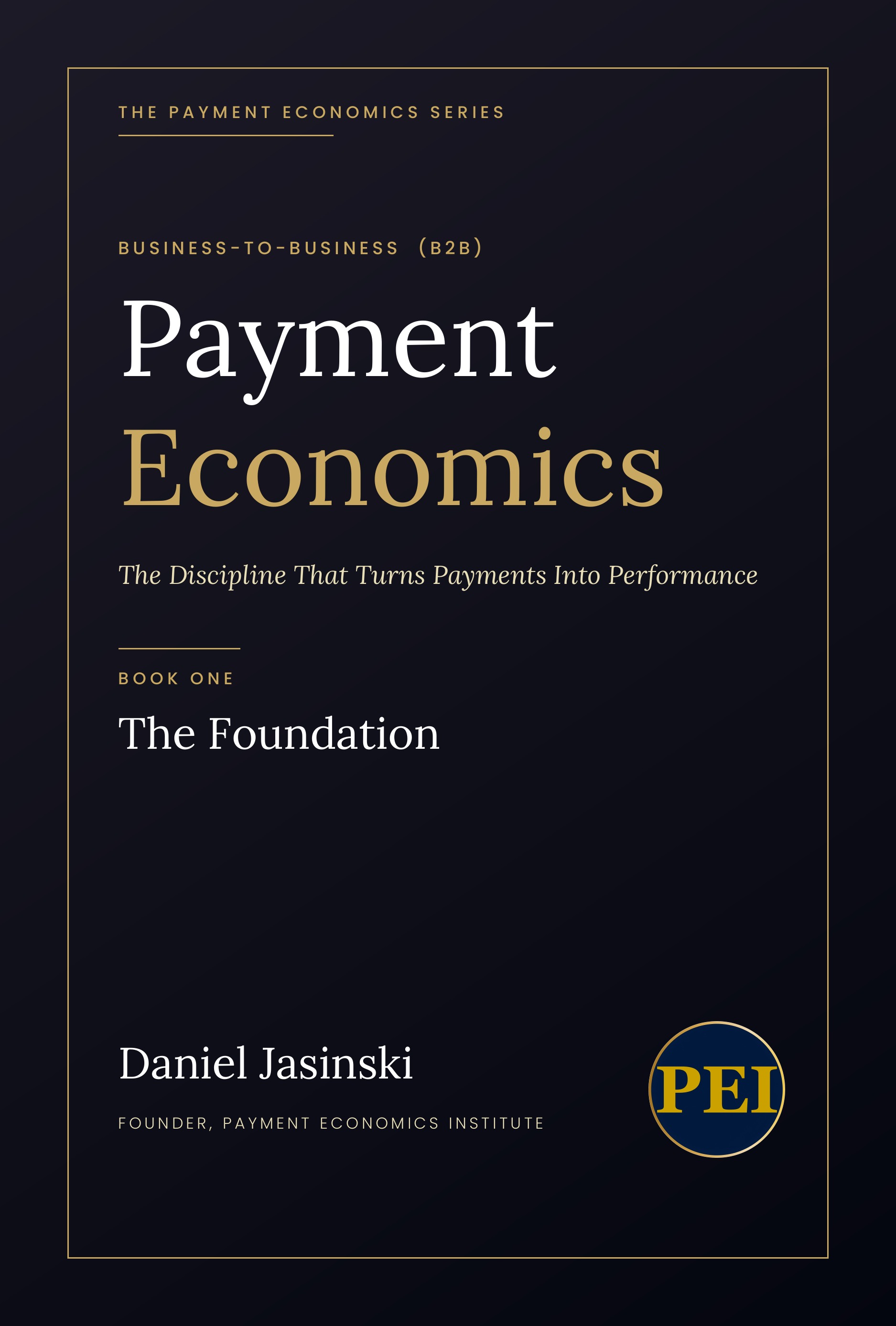
The origin of the discipline, the Payment Yield formula, the Payment Portfolio Manager role, and the case for treating enterprise payments as a strategic financial function. Based on Issues 1–10 of the journal, expanded into narrative form. Available on Amazon in print and as a digital download. The foundational text for anyone new to Payment Economics.
View & purchaseThe implementation playbook. Covers measurement systems, payment method economics, supplier segmentation, the Payment Efficiency Index, objection navigation, technology selection, working capital integration, and the full portfolio view. Maps to Issues 11–25 of the journal. Publication planned for late 2026.
The Payment Economics Foundations certification formalizes practitioner expertise with a verifiable, vendor-neutral credential.